Applied AI · Public GitHub Release
Tetris AI Lab
End-to-End AI Gameplay Agent
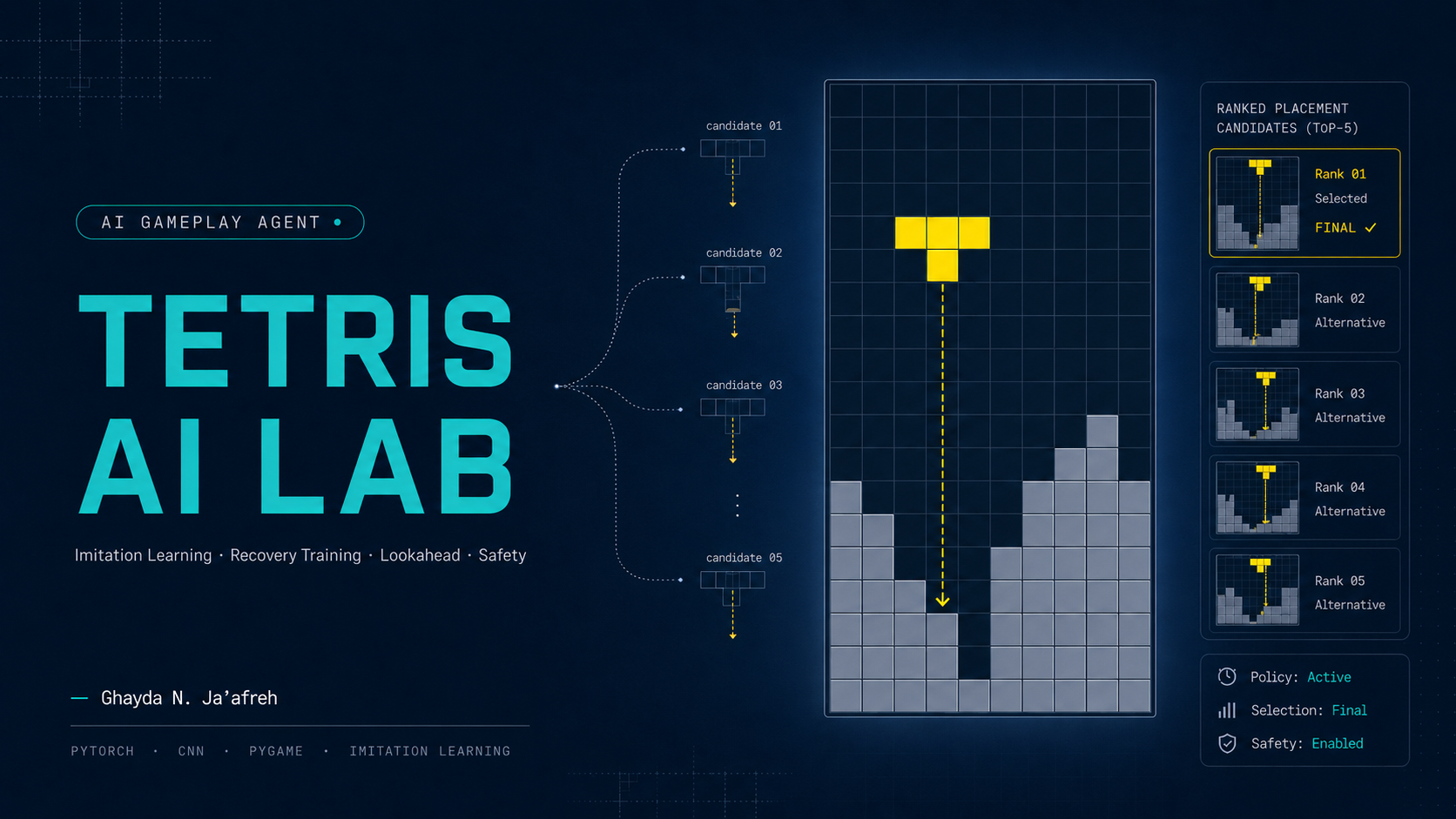
AI agent trained from expert gameplay and strengthened with recovery training, Top-5 one-piece lookahead, and a limited safety filter.
OVERVIEW
From learned placements to a complete AI system
Tetris AI Lab is an end-to-end machine-learning project that studies how an AI agent can learn placement behavior from expert gameplay and become more reliable in long-running play. The project began with a CNN placement policy trained from video-derived Classic Tetris examples and evolved into a hybrid agent combining learned candidate rankings with recovery-focused training, simulator-verified augmentation, one-piece lookahead, and a limited safety filter.
The final result is a complete Python/Pygame application with autonomous AI play, human play, Human vs Final AI, Greedy vs Final AI, replay viewing, screenshots, settings, and reproducible evaluation workflows.
PROJECT GOAL
More than predicting the next move
The objective was not simply to train a neural network to classify Tetris placements. The broader challenge was to build a testable AI system that could learn from expert demonstrations, survive imperfect states, reveal failure modes, and show whether each engineering change produced measurable improvement in actual gameplay.
Learn placement behavior from expert gameplay.
Expose the model to difficult states that expert demonstrations rarely contain.
Evaluate high-probability model suggestions with limited one-piece lookahead.
Evaluate the deployed agent using survival behavior in addition to offline model metrics.
DATA PIPELINE
From tournament footage to reproducible training data
The training workflow was built from video-derived Classic Tetris examples rather than a manually prepared toy dataset.
Gameplay footage was converted into examples representing board states and expert placement decisions.
Repeatable rules removed invalid or unsuitable examples before training.
Semantic duplicate handling reduced unwanted repetition in the training data.
Train, validation, and test partitions were separated by source video to reduce leakage.
AI APPROACH
A learned policy strengthened with controlled reasoning
CNN Placement Policy
The neural network ranks candidate placements from the current board state and incoming piece information. It remains the primary learned component of the final agent.
Recovery Training
Simulator-generated difficult states expose the policy to situations that are uncommon in strong expert demonstrations but common after AI mistakes.
Verified Augmentation
Mirror augmentation is validated through the simulator so transformed examples remain consistent with legal Tetris behavior.
Top-5 Lookahead + Safety
The final agent evaluates the CNN's highest-ranked candidates using one-piece lookahead and applies a limited safety override to reduce catastrophic placements.
PERFORMANCE EVOLUTION
Each stage was evaluated as an agent, not only as a classifier
The benchmark summaries show a clear increase in average survival as recovery, safety, and lookahead components were added.
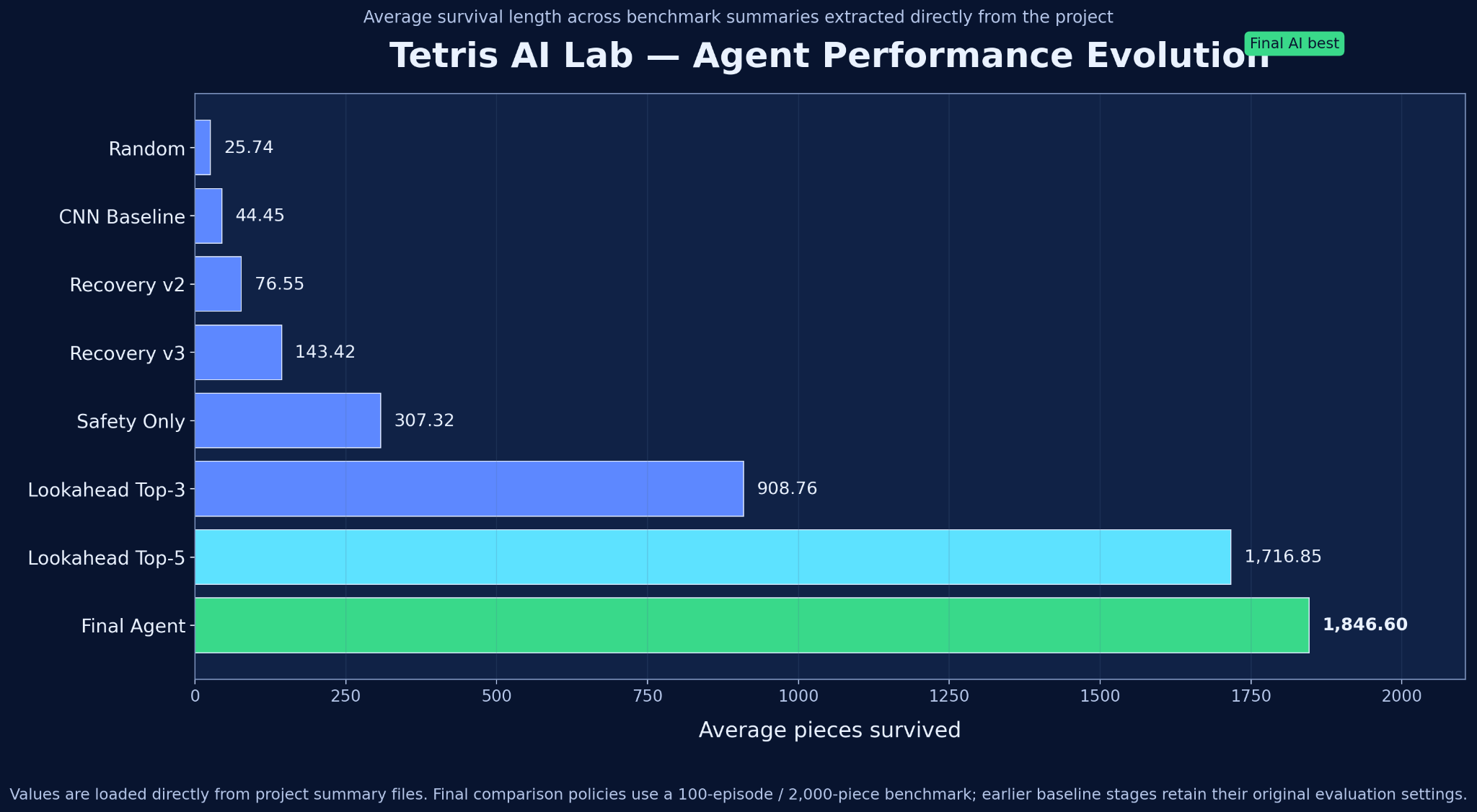
Average pieces survived, as reported in the project benchmark summaries. The final comparison policies use a 100-episode / 2,000-piece benchmark; earlier stages retain their original evaluation settings.
WHY THE HYBRID AGENT MATTERS
Greedy predictions can look good locally and still fail over time
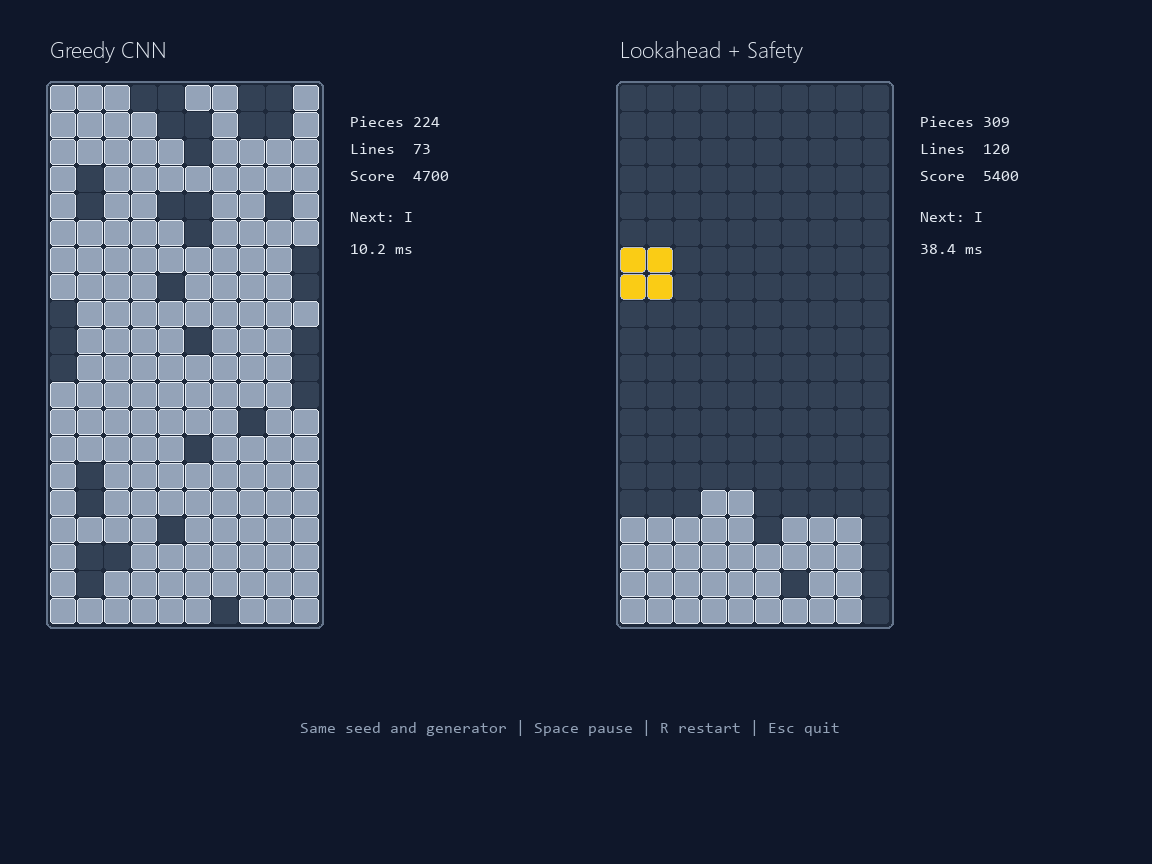
Small structural mistakes accumulate in a sequential environment. The enhanced agent keeps the CNN as the learned policy while allowing limited decision-time reasoning to reject some high-impact choices.
DEMO VIDEO
See the application and agent in motion
The demo shows the project interface, gameplay modes, and final AI behavior inside the released desktop application.
APPLICATION MODES
Built as an interactive application, not only a training notebook
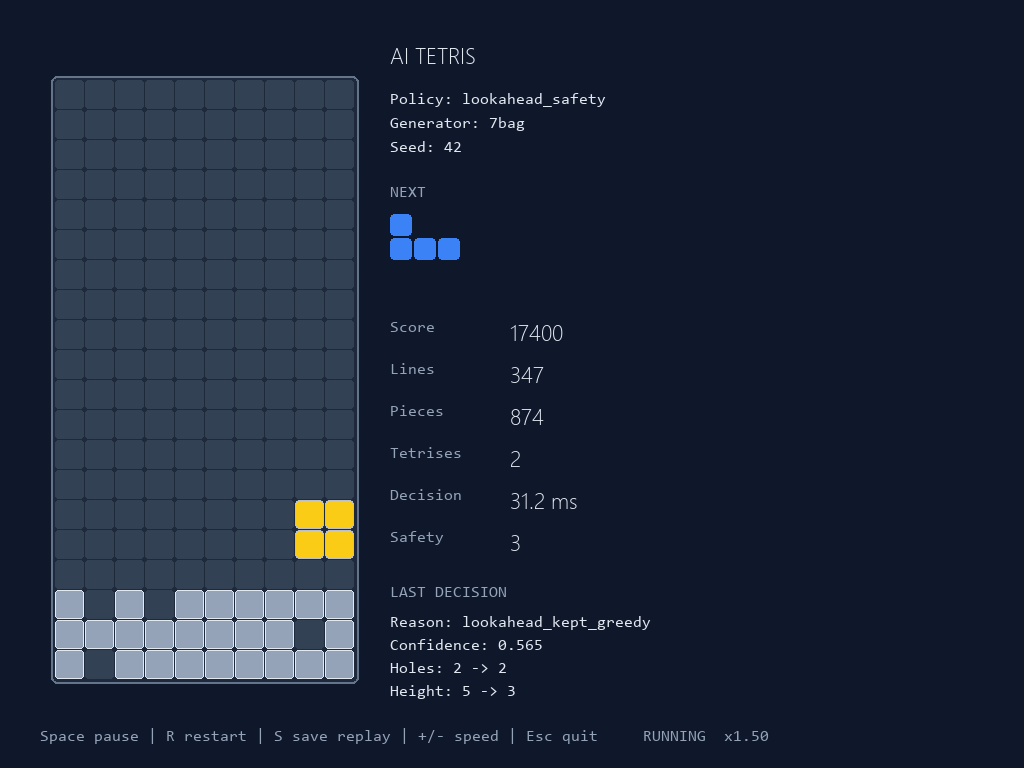
Runs the final policy with live score, line, piece, timing, confidence, and safety information.
Allows the same environment to be played directly by a human.
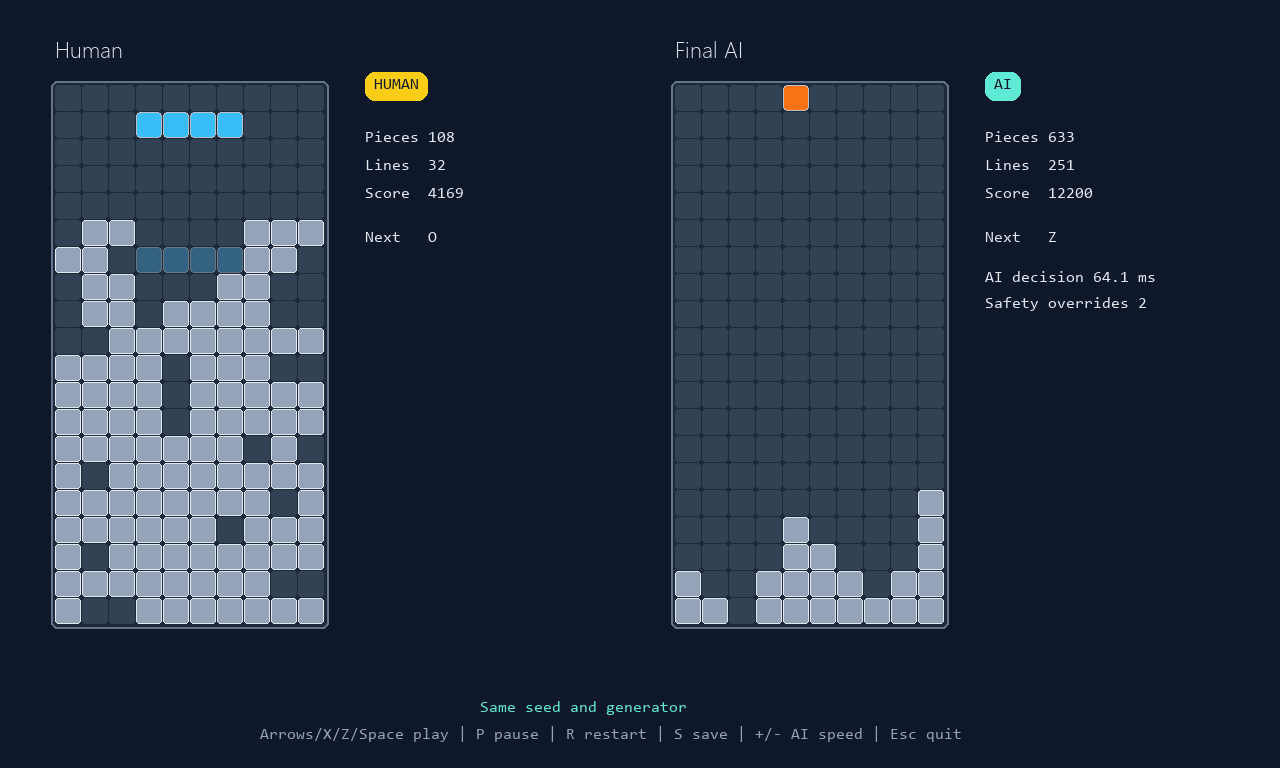
Compares human and AI gameplay under the same seed and generator.
Shows the practical difference between direct CNN selection and the enhanced agent.
Supports replaying recorded sessions for inspection and comparison.
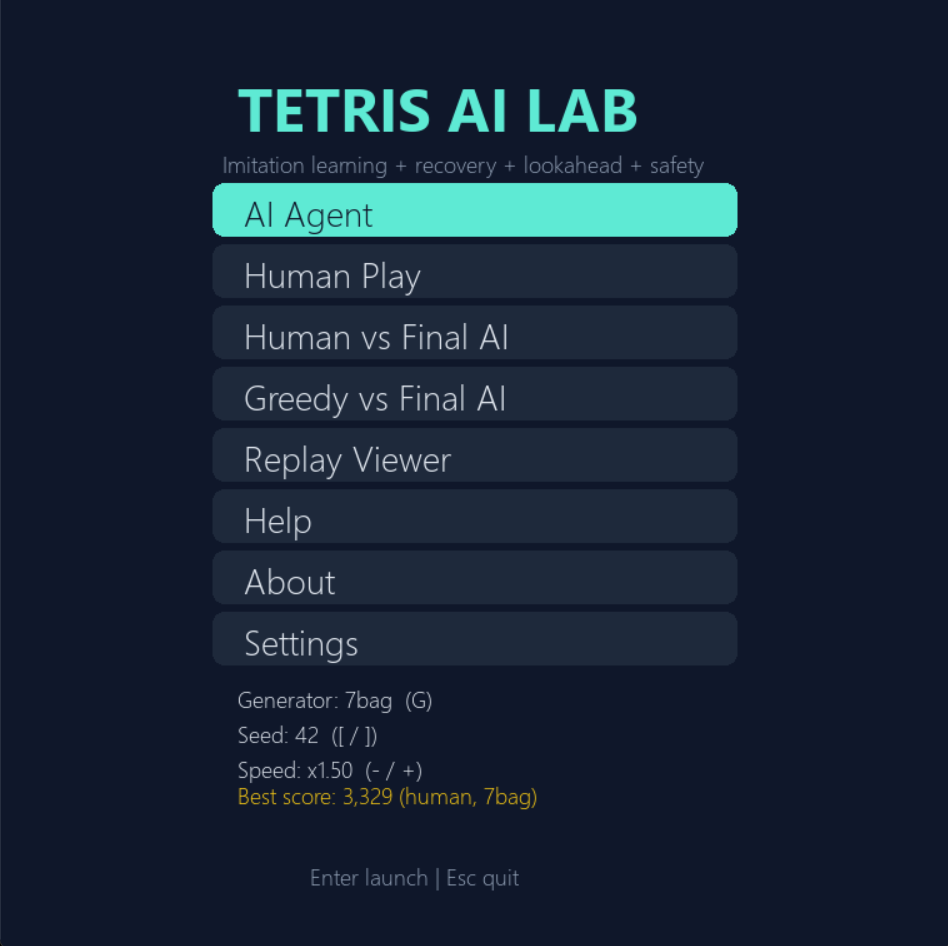
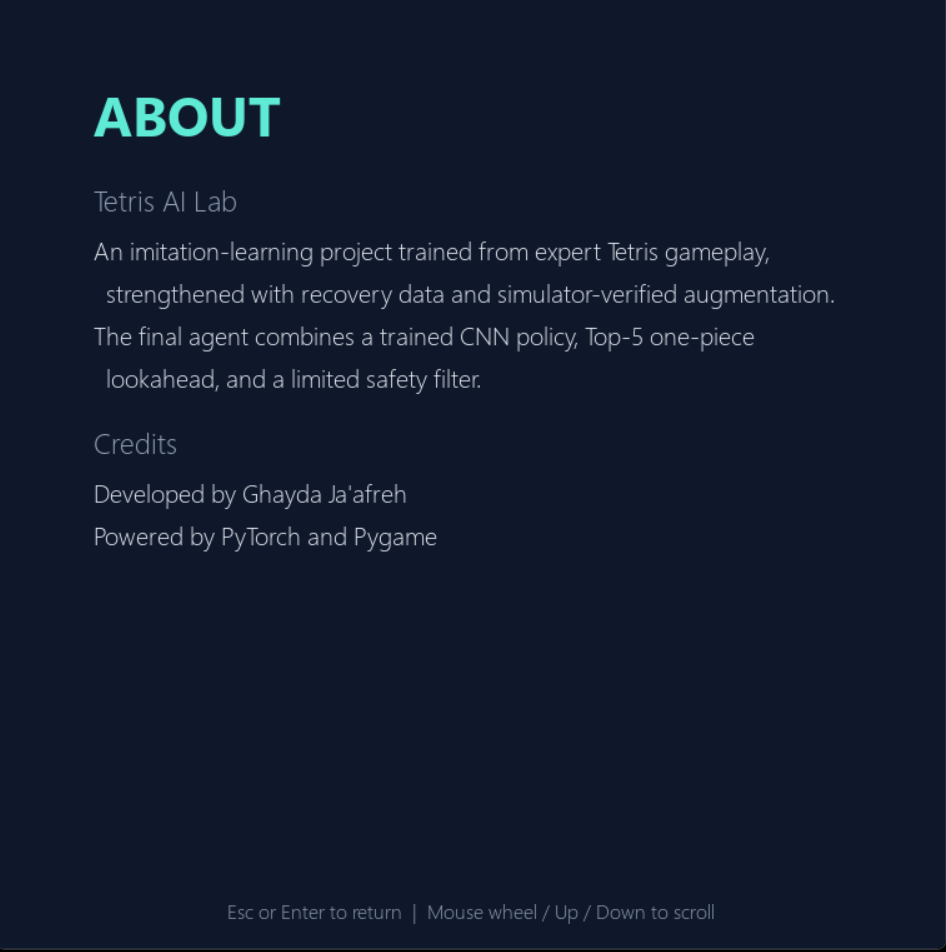
Includes runtime controls, screenshots, help, about information, and configurable gameplay settings.
PROJECT GALLERY
Interface, comparisons, and system behavior
ENGINEERING LESSONS
The gap between a good model and a good deployed agent
Distribution shift
Expert demonstrations mostly contain healthy boards. AI errors can move the game into unfamiliar states, motivating recovery-focused training.
Offline accuracy is not enough
A plausible single move can still damage long-term survival, so gameplay evaluation was treated as a separate measure of system quality.
Error accumulation
Small placement errors compound over hundreds of pieces, which made limited lookahead and safety checks useful.
Learned vs engineered behavior
The final design preserves the CNN as the main policy and uses additional logic selectively rather than replacing learning with a hand-built heuristic bot.
TECH STACK
Tools used across the full workflow
ProgrammingPython
Machine LearningPyTorch · CNN
ApplicationPygame
Data & ExperimentationVideo-derived data · cleaning · splitting · recovery data · augmentation · benchmark tracking
Agent EngineeringTop-K ranking · one-piece lookahead · safety filtering
DevelopmentGit · GitHub · debugging · testing · documentation
PUBLIC GITHUB RELEASE